
 EN
EN

When buyers and procurement managers evaluate swing set bulk orders, one of the first questions they ask is whether a supplier can truly scale without cutting corners on safety. The answer depends entirely on the manufacturer's production infrastructure, quality control systems, and material sourcing discipline. For swing set bulk orders of any significant volume, these three factors are non-negotiable.
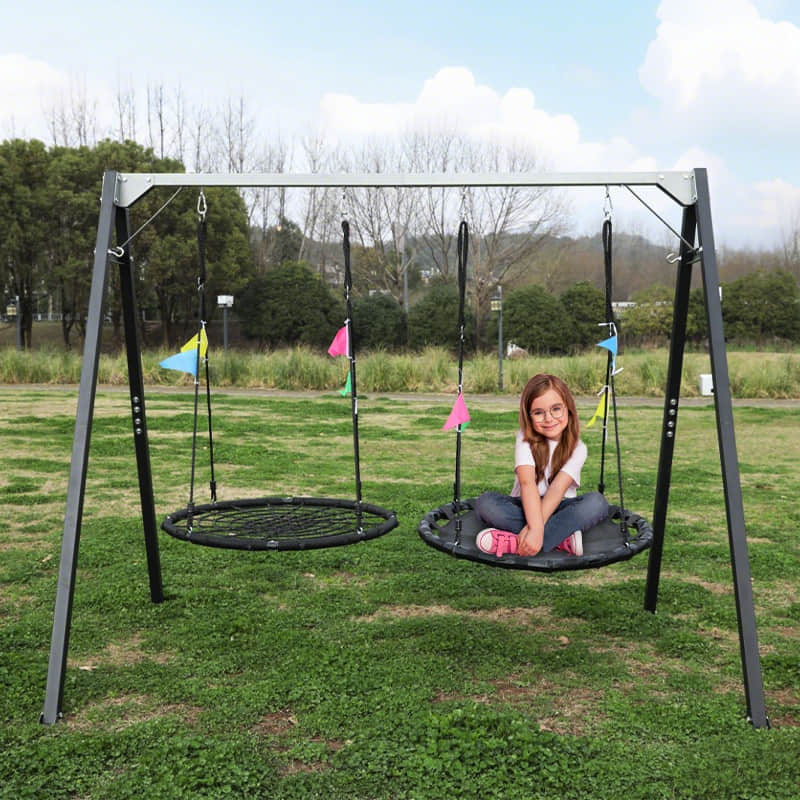
A factory operating over 12,000 square meters of dedicated production workshops has a structural advantage when handling swing set bulk orders at scale. This level of physical capacity is not merely about floor space — it reflects an integrated manufacturing ecosystem where fabrication, finishing, quality inspection, and packaging can all operate simultaneously without bottlenecks. Understanding how this translates into reliable, safety-compliant swing set bulk orders is what this article is designed to explain.
Production Scale and Its Role in Swing Set Bulk Orders
Why Workshop Size Directly Affects Bulk Order Reliability
Handling swing set bulk orders is fundamentally different from producing small batches. When a factory processes swing set bulk orders at volume, every production stage must be organized to prevent delays, material inconsistencies, and quality gaps. A 12,000㎡ facility provides the dedicated zones needed for each production phase — steel cutting, galvanizing, powder coating, frame assembly, and final inspection — to run in parallel rather than sequentially. This parallelism is what allows swing set bulk orders to be completed on time without sacrificing thoroughness.
Factories with insufficient workshop space are forced to compress or skip process stages when swing set bulk orders spike in volume. This is where safety risks typically enter the picture. By contrast, a large-scale facility can absorb swing set bulk orders without disrupting the standard production rhythm, meaning every unit receives the same level of attention regardless of total order size.
How Dedicated Zones Protect Quality in Swing Set Bulk Orders
Dedicated production zones are critical for maintaining consistency across swing set bulk orders. When galvanizing lines, welding stations, and coating booths are physically separated and purpose-built, the risk of cross-contamination, process skipping, or rushed transitions is significantly reduced. For swing set bulk orders involving galvanized steel frames, the galvanizing process must achieve full coverage and uniform thickness on every component. This standard is only achievable when the production line has enough space to handle swing set bulk orders without crowding the process flow.
Safety Standards That Scale With Swing Set Bulk Orders
Material Integrity Across Large Swing Set Bulk Orders
The most common safety failure point in swing set bulk orders is inconsistent material quality. When factories rush swing set bulk orders to meet deadlines, steel grade selection and galvanizing depth are the first areas to suffer. A responsibly managed factory maintains fixed material specifications for all swing set bulk orders regardless of volume. This means every steel tube used in swing set bulk orders meets the same tensile and corrosion-resistance standards, whether the order is 100 units or 10,000 units.
For swing set bulk orders involving outdoor metal frames, hot-dip galvanizing or electrostatic powder coating should be standard, not optional upgrades. These surface treatments protect against rust, UV exposure, and mechanical wear — all critical safety factors for children's outdoor equipment. Maintaining these treatments consistently across swing set bulk orders requires dedicated processing equipment and strictly enforced protocols.
Quality Inspection Protocols for Swing Set Bulk Orders
A factory serious about safety in swing set bulk orders must implement multi-stage inspection systems, not just final-stage checks. Incoming raw material inspection, in-process dimensional checks, weld integrity testing, and load-bearing stress tests should all be built into the production workflow for swing set bulk orders. Without these checkpoints, defects from early stages can compound invisibly and result in unsafe finished products delivered at scale.
For swing set bulk orders, statistical sampling alone is insufficient. Each production batch within a large swing set bulk order should be traceable back to its raw material lot, welding operator, and inspection record. This traceability system ensures accountability and makes it possible to identify and address any safety deviation before swing set bulk orders leave the factory floor.
Fulfillment Capacity for Super-Large Swing Set Bulk Orders
Production Scheduling and Lead Time for Swing Set Bulk Orders
Super-large swing set bulk orders require more than just physical capacity — they require disciplined production scheduling. A factory managing swing set bulk orders at scale must allocate dedicated time slots, material reserves, and labor capacity well in advance. Without this planning discipline, swing set bulk orders for seasonal peaks such as spring and summer can overwhelm production lines that lack structured workflows.
Lead time reliability is one of the most commercially important factors in swing set bulk orders for B2B buyers. When a retail chain, playground operator, or school district places swing set bulk orders, they are operating on installation timelines and inventory cycles. A factory with proven production scheduling can commit to and deliver swing set bulk orders on agreed dates, which builds long-term procurement confidence.
Packaging and Logistics Readiness for Swing Set Bulk Orders
Fulfillment of swing set bulk orders does not end at production. Packaging design for swing set bulk orders must protect steel components during container shipping without excessive material waste. Carton specifications, foam padding, and bundling standards should all be engineered specifically for the product dimensions in swing set bulk orders. A factory with a dedicated packaging zone can standardize this process, reducing transit damage claims across swing set bulk orders.
Export documentation, compliance certifications, and container loading plans are equally important for international swing set bulk orders. Factories handling swing set bulk orders for overseas buyers must maintain current certifications — such as EN 71, ASTM F1148, or equivalent standards — to ensure the products in swing set bulk orders comply with destination-market regulations. This documentation readiness is part of what separates professional-scale swing set bulk order fulfillment from ad hoc production.
FAQ
What minimum order quantity is typical for swing set bulk orders from a large factory?
Most factories capable of handling large swing set bulk orders set a minimum of 50 to 200 units depending on the product model. Super-large swing set bulk orders typically start at 500 units or more, and factories with over 12,000㎡ of production space are generally equipped to handle these volumes without lead time extensions.
How do factories maintain safety standards when swing set bulk orders increase suddenly?
Responsible factories maintain safety in swing set bulk orders by using pre-approved material suppliers, fixed process specifications, and multi-stage inspection systems that do not scale down under volume pressure. The key is that safety protocols in swing set bulk orders must be process-embedded rather than inspection-dependent at the end of the line.
What certifications should swing set bulk orders carry for export markets?
Swing set bulk orders destined for European markets should carry EN 71 and EN 1176 certification. For North American swing set bulk orders, ASTM F1148 and CPSC compliance are typically required. Always verify that swing set bulk orders include current test reports from accredited third-party laboratories before confirming the order.